
Let me be real with you for a second.
You have tried it. Maybe five times. Maybe ten. You set the alarm for 6 AM, made a beautiful routine on paper — workout, journaling, healthy breakfast, meditation — and by Day 3, you were back to scrolling your phone in bed until 8:30.
Does that sound familiar?
You are not lazy. You are not undisciplined. Your morning routine is simply designed wrong. And in this post, I am going to show you exactly why it keeps failing — and what actually works in 2026.
Quick Fact: Research shows the #1 reason morning routines fail is not laziness — it is overambition. People design 90-minute routines when they should start with just 15 minutes.
Reason #1: You Are Copying Someone Else’s Routine
This is the biggest mistake I see. You watch a ‘5 AM Morning Routine’ YouTube video, get inspired, and try to copy it exactly. The problem? That routine belongs to someone else’s life, not yours.
A mom of two cannot run the same morning as a single 25-year-old entrepreneur with no commitments. A night owl cannot force herself into a 4:30 AM wakeup and expect to thrive.
Science actually backs this up. Every person has a “chronotype” — a biological preference for when they feel most alert. Forcing your body against its chronotype does not build discipline. It builds exhaustion.
What to do instead:
- Find YOUR natural wake time — not someone else’s ideal
- Build a routine that fits into your real life, not an aspirational fantasy
- Start by adding just ONE habit to your existing morning

Reason #2: You Are Trying to Change Everything at Once
I did this too. I made a 12-step morning routine — drink water, stretch, journal, meditate, workout, read, affirmations, plan my day… It collapsed by Wednesday.
Here is what habit science actually tells us: stacking too many new behaviors at once creates cognitive overload. Your brain literally cannot handle that many changes simultaneously.
According to research cited in James Clear’s Atomic Habits, it takes an average of 66 days to form a single new habit. Not 21 days — 66.
What to do instead:
- Pick ONE anchor habit to start with — just one
- Do it consistently for 14 days before adding anything new
- The best anchor habit? Drinking a glass of water the moment you wake up — simple, fast, and it signals your brain that morning has begun
Reason #3: You Are Reaching for Your Phone First Thing
Raise your hand if you check Instagram, WhatsApp, or emails within the first 5 minutes of waking up. Most of us do.
Here is the problem: your phone floods your brain with reactive, stress-triggering information before you have had even a single moment to yourself. Studies consistently show that people who reach for their phones immediately upon waking report significantly higher morning anxiety levels.
You go from zero to chaos in 30 seconds. And then you wonder why your morning feels rushed and overwhelming.
What to do instead:
- Keep your phone out of the bedroom entirely — charge it in another room
- Buy a real alarm clock if needed
- Give yourself a phone-free 30 minutes every morning — even 10 minutes makes a difference
Reason #4: You Are Not Preparing the Night Before
Here is something most morning routine advice misses completely: a great morning actually starts the night before.
Every small decision you have to make in the morning — what to wear, what to eat, where your keys are — drains your mental energy. By the time you sit down to journal or exercise, your brain is already tired.
This is called “decision fatigue.” Making choices at night when the stakes are low preserves your morning willpower for the things that actually matter.
The 10-minute night prep routine:
- Lay out your outfit for tomorrow
- Prep your breakfast or at least decide what it will be
- Place your keys, bag, and essentials in one designated spot
- Write down your top 3 priorities for the next day
- Put your phone on charge — outside the bedroom
Reason #5: Your Routine Has No Joy In It
Be honest — does your morning routine feel like a punishment?
If every item on your list is something you “should” do rather than something you actually enjoy, you are setting yourself up to fail. We are human. We avoid things that feel like pain.
The most sustainable morning routines include at least one thing the person genuinely looks forward to. For me, it is my coffee ritual — 10 quiet minutes with a good cup, no phone, no noise. That one thing pulls me out of bed on hard days.
What to do instead:
- Identify ONE thing you actually enjoy and make it part of your morning
- Your favorite podcast, a book, 5 minutes outside, a special breakfast — anything counts
- Anchor the habits you “need” to do around the one you “want” to do
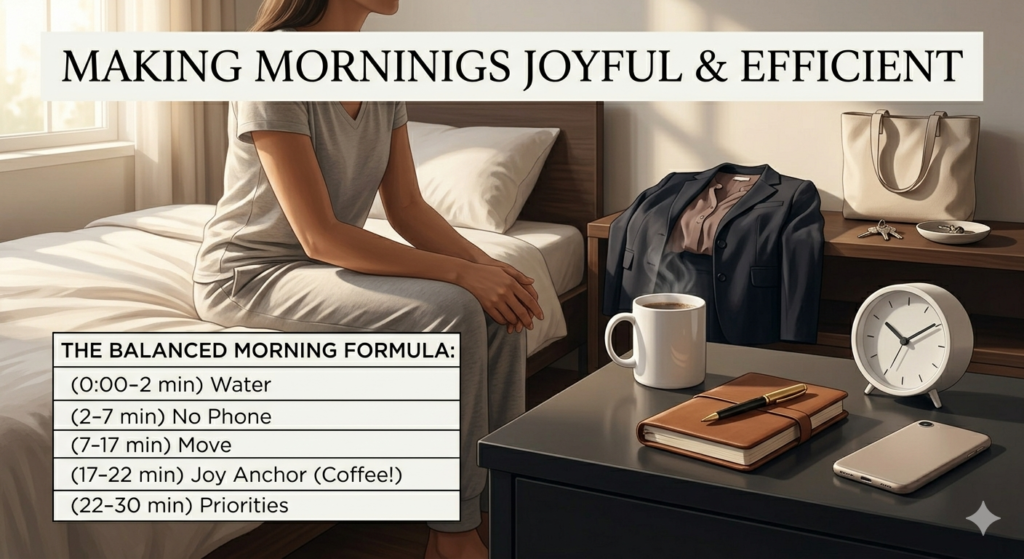
The Marie Dee Morning Routine Formula That Actually Works
After years of trial and error, here is the simple framework I use and recommend:
| Time | Action | Why It Works |
| 0:00 – 2 min | Drink a full glass of water | Rehydrates body, signals brain |
| 2 – 7 min | No phone — sit quietly or stretch | Protects you from reactive stress |
| 7 – 17 min | Move your body (walk, yoga, anything) | Boosts dopamine and serotonin |
| 17 – 22 min | Enjoy your joy anchor (coffee, book, etc.) | Makes you WANT to get up |
| 22 – 30 min | Review your 3 priorities for the day | Sets clear intention and focus |
Total time: 30 minutes. That is it. No two-hour commitment. No waking up at 4 AM. Just 30 intentional minutes that set the tone for your entire day.
Frequently Asked Questions
Q: What if I miss a day?
One missed day does not break a habit. Research consistently shows that missing once has almost no impact on long-term habit formation. The “all or nothing” mindset is what breaks routines, not a single skipped morning. Just show up tomorrow.
Q: What is the best time to wake up?
The one that works for YOUR life. There is nothing magical about 5 AM. A consistent wake time — whatever it is — is far more important than an early one.
Q: How long until my routine feels natural?
Give it 30 days of honest effort. The first two weeks feel hard. Weeks 3 and 4, it starts to feel automatic. By Day 30, it feels weird NOT doing it.
Final Thoughts
Your morning routine is not failing because you are weak. It is failing because it was never designed for your real life in the first place.
Stop copying. Stop overcomplicating. Start with one small habit, protect your first 30 minutes, and make it something you actually want to do.
Your mornings do not have to be perfect. They just have to be consistently yours.
If this post helped you, share it with someone who is also struggling with their morning routine. And drop a comment below — I would love to hear what your one anchor habit will be!